
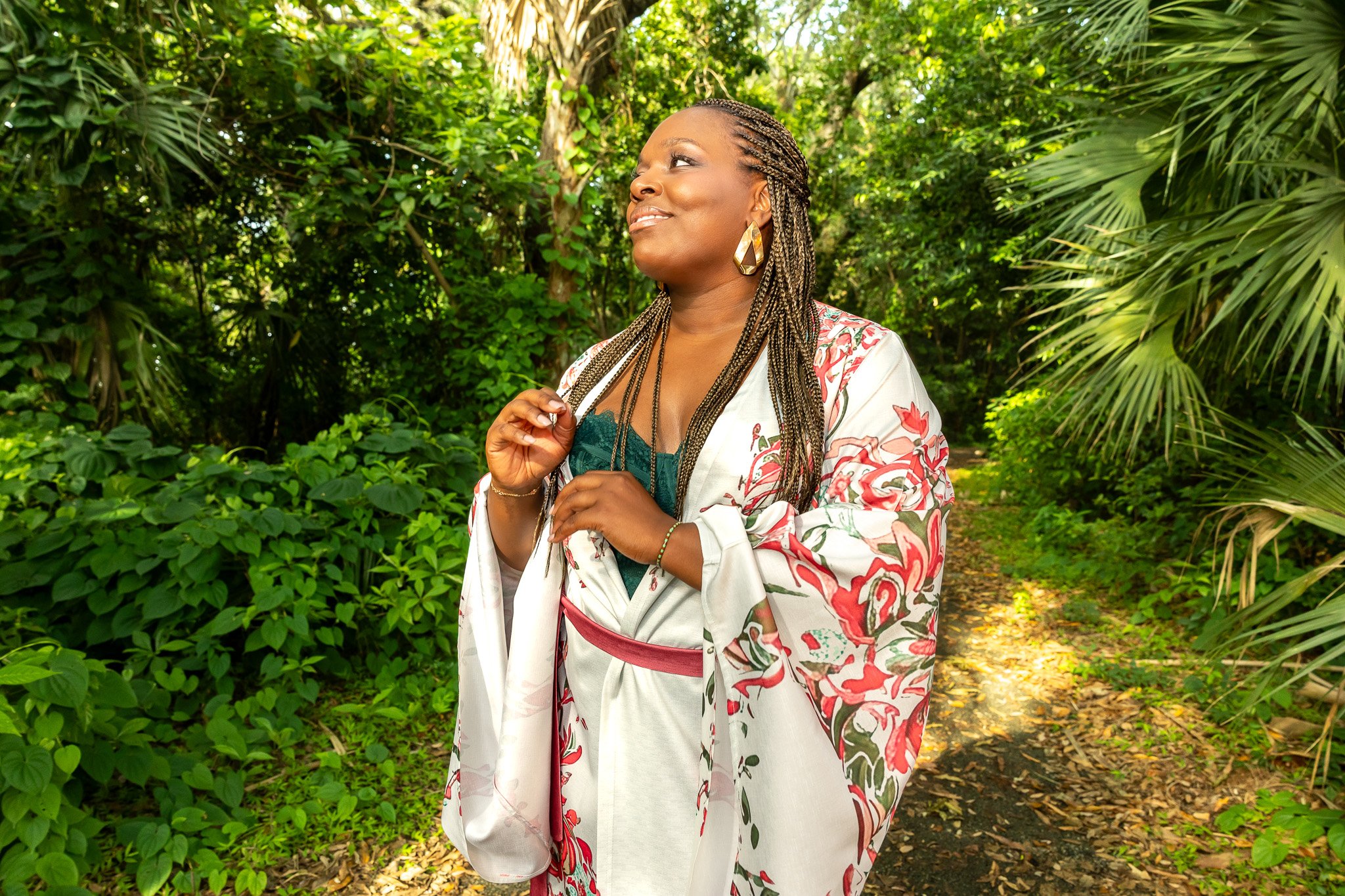
Written by Rey White
Photographed by Erika L. Kolakowski
Makeup by Laura Martínez
Hair by Christelle Francois
Direction by Rey White
Music found Jessy Díaz before she ever had a name for it. She grew up in Matanzas, surrounded by drums, rumba, and the voices of her family. From Cuba to the United States, from percussion to singing, and from popular music to jazz, she has built a voice all her own without leaving her roots behind.
We sat down with her to talk about the music that raised her, the voices that inspire her, and the sound she has shaped over the years. We invite you to get to know her story.
Tesón Magazine: What role did music play in your home and family while you were growing up?
Jessy Díaz: I was born in my grandmother's house and spent the first years of my life there, in a neighborhood called Simpson in Matanzas. Cuban traditions are very much alive in that part of town, so I grew up surrounded by batá drumming, plenty of rumba, danzón, and güiro and bembé ceremonies. That was just everyday life for me.
Blackouts were very common in our neighborhood, and whenever the power went out, my family would start drumming on the edges of the beds. Meanwhile, I'd be right in the middle of it, three or four years old, dancing and singing. There are even recordings! My mom still has them.
For someone discovering your music for the first time, how would you describe your sound?
Jessy Díaz: My sound is a blend of the neighborhood, of rumba, and of everything I grew up listening to, which later merged with my formal training. The funny thing is that I entered music school at 10 to study percussion, not voice, because I was already singing what was considered popular music, like danzón, son, and cha-cha-chá.
I also sang in a choir led by an outstanding teacher from my hometown, Zenaida Menéndez. Then, at 14, I moved to another school to continue my music studies. This time I studied percussion alongside music theory courses like music history, harmony, solfège, and music appreciation. After that, I earned my bachelor's degree in percussion and musicology. So my life has always been full of formal study, but I never separated myself from popular music, from singing, or from my city, Matanzas.
That's why I think of my sound as the sum of many years of study, many influences, and many discoveries. It also comes from my experiences in conservatory and from the cultural exchange with young people from all over Cuba. Also, the parties and the nightclubs in Havana. All of that very active life is what shaped my sound. But I never strayed from my roots or from my Matanzas rumba.
TM: How did your life and your musical career change when you moved to the United States?
Jessy Díaz: Well, I came alone the United States in 2016 at the age of 25. My father was here, but he'd only been here a short while. Then I went off to live on my own.
My goal was to make a living from music. A lot of people disagreed, because of the stability you need here, so I ran into the comments you always hear when you're arriving in a new country like “Maybe you should leave your dreams behind”.
But I always had opportunities to sing and to teach music. Then, in 2019, I said to myself, "I need a change in my life." I wanted to study jazz, which was something I owed myself. So I took the entrance exams for a university in Atlanta, was accepted, and moved there to study jazz and voice, specifically.

I had never studied voice before, so it was a new and wonderful experience. And all of it was in English. Here in Miami, where I live now, people speak English, but never as constantly as I had to in Atlanta. On top of that, I wasn't used to academic English. I had to write in English, think in English. I'm not sure I pulled off that last part, but I gave it a try.
And to add to your earlier question, I think studying jazz is what gave my sound its definition. I adore my Cuban music, but there always has to be a touch of jazz in everything I do for me to feel that it's really me.
TM: Celia Cruz has been an important influence on you. If you could sing a duet with her, which song would you choose, and why?
Jessy Díaz: There's a bolero she used to perform called "Vieja Luna" that I'm fascinated by. You hear the melody and the lyrics, and it's like watching the moon rise.
I think that's the song I'd love to sing with her, so I could hear her up close and take in the beauty of her voice, you know? I picture myself listening in silence, soaking in that beauty before singing my little part.
TM: What does Celia Cruz represent to you as a role model, beyond the music?
Jessy Díaz: Believe it or not, I came to know Celia Cruz relatively late, because in Cuba her music was banned, and still is, so I never had the chance to really listen to her in depth.
But when I moved to the United States and started performing, I always sang "La negra tiene tumbao" and "La vida es un carnaval." People would tell me, "Wow, your voice sounds so much like hers." And it felt strange to me, because I couldn't hear the resemblance.
So I decided to sit down and study her music carefully, and I realized that what people see in me isn't a voice or a timbre identical to hers, even if there are similarities. What people see of Celia Cruz in me is the spirit, the flavor, and the soul of a sonera.
I'm always proud of that comparison. And that's how I really discovered Celia Cruz and came to admire her even more. She also left behind such a wealth of recordings and such a wonderful repertoire that you can keep learning from her forever.
And now I have the blessing of having met her niece and of being fairly close with her. I love it when she shares stories about Celia. I like feeling her close, feeling Celia, you know? It's as if she were looking at me through time with her niece.
TM: What do you want someone to feel when they hear you live?
Jessy Díaz: I want the people who hear me live to feel my soul, to feel my passion for dance music, which is what goes with me and who I am. I love singing boleros, but what really fascinates me is singing and discovering music you can dance to.
I'm someone who is always studying, always listening to new music, always giving myself the chance to improve and grow. I think audiences pick up on that: that I'm open, that I'm constantly growing, and that I love what I do.
So that's what I want people to take away every time they see me: a lot of passion, a lot of heart, and a lot of respect for every musician on the stage. Because it's not just about me. It's a collective of people who put their souls and their full attention into making the music flow, into doing good work, and into making sure the audience enjoys it.
Click here to see Jessy’s full cover shoot for Edition 6 of Tesón Magazine.
Learn more about Jessy Díaz and listen to her music here:
Instagram: @jessicasingeratl
Spotify: Jessy Díaz
YouTube: Jessy Díaz Music
Apple Music: Jessy Díaz
Tidal: Jessy Díaz